Cheque Dishonour Case in Bangladesh: Section 138 Timelines and Court Procedure
You gave a business partner Tk 8 lakh. In return, you received a cheque. The bank returned it with the words "insufficient funds." What now?
Do not panic, but do not wait either. In a cheque dishonour case (চেক ডিজঅনার মামলা), the law runs on strict deadlines. Miss one, and your case can fail before it starts.
This guide explains the steps, the time limits, the courts involved, and what changed in 2026.
What is a cheque dishonour case?
A cheque is dishonoured (ডিজঅনার) when the bank returns it unpaid. In Bangladesh, this can be a criminal offence under Section 138 of the Negotiable Instruments Act, 1881 (NI Act).
The section applies when a cheque is returned unpaid because the account has too little money, or because the amount is more than the bank arrangement allows. The person who drew the cheque (the drawer) is then deemed to have committed an offence.
What is the punishment under Section 138?
The punishment is imprisonment up to one year, or a fine up to three times the cheque amount, or both.
If a fine is collected, the court pays the cheque holder the amount up to the cheque's face value from it. The holder can also go to a civil court for any part of the cheque value that remains unpaid. So the criminal case does not take away your right to a money recovery suit.
In practice, courts focus on getting your money back. The High Court Division has observed in a recent judgment that the main purpose of these cases is recovery of the cheque amount, not sending the drawer to jail.
Step-by-step: from bounced cheque to court
Step 1: Present the cheque on time
Deposit the cheque within its validity period. A cheque is generally treated as valid for six months from the date written on it. Do not wait until the last day.
Step 2: Collect the dishonour slip
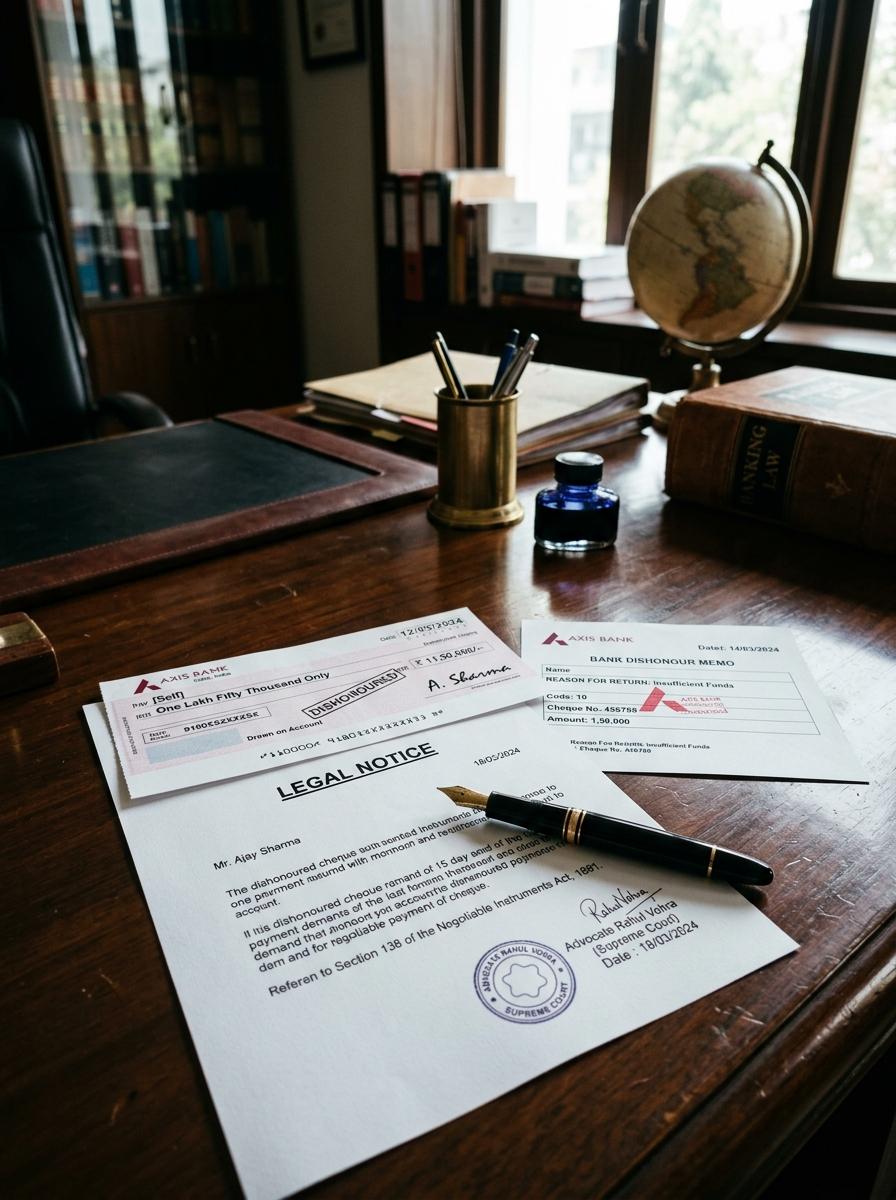
The bank gives you a cheque return memo (ডিজঅনার স্লিপ) stating the reason. Keep the original safe. The date you receive this information starts your first deadline.
Step 3: Send a legal notice within 30 days
You must send a written demand notice to the drawer within 30 days of getting the bank's information that the cheque was returned. This is the legal notice (উকিল নোটিশ).
Send it through your advocate by registered post with acknowledgment due, and keep every receipt. If you have more than one dishonoured cheque, speak to your advocate before sending notices, because a separate case is generally needed for each cheque.
Step 4: Wait 30 days for payment
The drawer then has 30 days from receiving the notice to pay. If the drawer pays in full, there is no offence. If not, your cause of action (মামলার কারণ) arises.
Step 5: File the complaint within one month
The court takes cognizance only on a written complaint by the payee or the holder in due course of the cheque. The complaint must be made within one month of the date the cause of action arises.
You file this complaint (a নালিশি মামলা / CR case) first before the Magistrate's court. In a metropolitan area, this is the Chief Metropolitan Magistrate (CMM) court. Elsewhere, it is the Chief Judicial Magistrate (CJM) court.
Step 6: Check whether mediation applies
This is new and important. See the 2026 section below.
Timeline at a glance
| Stage | Deadline | Legal basis |
|---|---|---|
| Present cheque to bank | Within cheque validity (generally 6 months) | Section 138 |
| Legal notice to drawer | Within 30 days of the bank's information | Section 138, proviso (b) |
| Drawer's time to pay | 30 days from receiving the notice | Section 138, proviso (c) |
| File complaint | Within 1 month of the cause of action | Section 141(b) |
Example (anonymised): A cheque is returned on 1 March and the payee gets the memo that day. The notice must go out by 31 March. Say the drawer receives it on 5 April. The payment window then ends around 5 May, and the complaint must be filed within one month of that point. Your advocate should calculate the exact dates for your case, because how days are counted can matter.
Which court hears the case? (2026 change)
Where you file: You start the case in the Magistrate's court (CMM in metropolitan areas, CJM elsewhere).
Where it is tried: This is what changed. Before 2026, following a 2020 High Court Division ruling, these cases were tried by the Joint Sessions Judge's court.
The Negotiable Instruments (Amendment) Act, 2026 (Act No. 65 of 2026) replaced clause (c) of Section 141. It followed an Ordinance issued in February 2026. The trial court now depends on the cheque's face value:
| Cheque face value | Trial court |
|---|---|
| Above Tk 5 lakh | Metropolitan Joint Sessions Judge or Joint Sessions Judge |
| Tk 5 lakh or less | Metropolitan Magistrate or Magistrate of the first class |
In simple words: a case of Tk 5 lakh or less is tried by a Magistrate. A case above Tk 5 lakh is tried by a Joint Sessions Judge. The aim is to reduce the load on higher courts and speed up smaller cases.
If your case was filed before this change, ask your advocate how the new rule affects it.
Pre-case mediation (2026)
Under the Legal Aid Services Act, 2000, as amended in 2025 and 2026, certain disputes must go through mediation (মধ্যস্থতা) at the Legal Aid Office before a case is filed in court. When the rule was introduced in 2025, cheque dishonour cases of lower value were among the listed disputes. The government is rolling this out district by district.
What this means for you: depending on your district and cheque amount, you may need to try mediation first. Do not let this make you miss the one-month filing deadline. Before doing anything else, ask your advocate whether mediation applies in your district and how it affects your time limits.
Documents you will need
- The original dishonoured cheque and the bank's return memo
- Copy of the legal notice, postal receipts and the acknowledgment slip
- Proof of the underlying transaction, such as an agreement, bank transfer record, invoices or messages
- Your ID and the drawer's full address
- A written timeline of events with dates
Can the accused appeal?
An appeal against a sentence under Section 138(1) is allowed only if at least 50% of the dishonoured cheque amount is deposited before filing the appeal, in the court that imposed the sentence. This is provided in Section 138A.
Common mistakes from practice
- Missing the 30-day notice window. This is the most common reason cases fail.
- Wrong address or no proof of delivery for the notice. Keep every receipt.
- Ignoring the one-month filing limit after the payment window ends.
- Settling informally without a written receipt. If the drawer pays part of the amount, record it in writing.
- Handling several cheques carelessly. Plan the notice and complaint for each cheque with your advocate.
- Not checking the mediation rule for your district before filing.
Cost and how long it takes
Court fees and professional fees vary from case to case, so they are not quoted here. Cases can take time because of court backlogs. No one can honestly promise a result or a date.
Key takeaways
- Present the cheque in time, then send the legal notice within 30 days.
- Give the drawer 30 days to pay.
- File your complaint within one month after that.
- Every case starts in the Magistrate's court (CMM or CJM). Cheques of Tk 5 lakh or less are tried by a Magistrate. Cheques above Tk 5 lakh are tried by a Joint Sessions Judge.
- Check whether pre-case mediation applies in your district.
Frequently Asked Questions (FAQ)
Find clear, expert answers to the most common questions regarding this article below.
Send the legal notice within 30 days of the bank's information. After the drawer's 30-day payment window ends, file the complaint within one month.
If full payment is made within the 30 days, the offence under Section 138 is not made out.
The law allows up to one year, but courts often focus on recovering the money. Outcomes vary from case to case.
The law requires a written notice. An advocate's notice is safer because it follows the correct format and gives proof of service.
Yes. Section 138(3) keeps the holder's right to claim any unpaid value in a civil court.
You file in the Magistrate's court (CMM or CJM). After the 2026 change, a cheque of Tk 5 lakh or less is also tried by the Magistrate. Check first whether mediation applies in your district.
No. Section 138A requires a deposit of at least 50% of the cheque amount before an appeal is filed.
The information provided in this article is for educational and general informational purposes under Bangladesh laws and should not be construed as specific legal advice. For formal counsel regarding your litigation or commercial matters, please consult directly with Advocate Ataur Rahman at our chamber.